Can you sell a house with an IRS tax lien on it? Usually, yes.
The IRS is paid from your proceeds at closing, or it issues a certificate that frees the house.
The lien itself is rarely what sinks a sale. Timing is.
Early help with an IRS tax lien can protect your closing.
Updated October 2026 · Reviewed by Amro Badran, EA
At a Glance
Yes, you can sell or refinance a house with an IRS lien. You need the right IRS certificate, and the IRS asks for at least 45 days to issue one.
- Selling with enough equity: pay the IRS from proceeds. Release follows within 30 days.
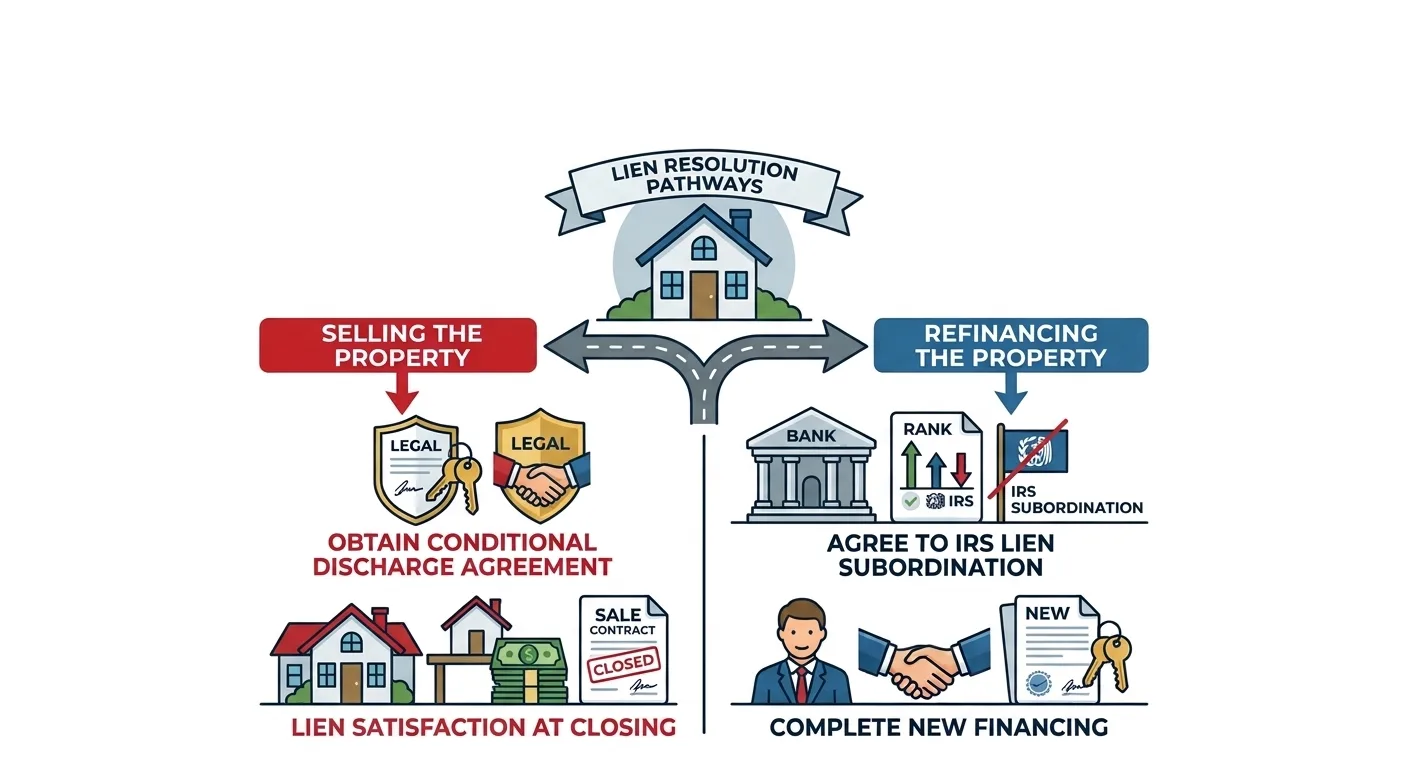
- Selling without enough equity: certificate of discharge, Form 14135.
- Refinancing: certificate of subordination, Form 14134.
- Clearing the public record: lien withdrawal, Form 12277.
Who this affects: Homeowners with a federal tax lien who plan to sell, refinance or clean up their title
In this article
- What an IRS lien means for your home
- Which lien tool fits your situation?
- Can you sell your house with an IRS lien?
- Can you refinance with a federal tax lien?
- How to get an IRS lien withdrawn
- Does an IRS lien expire after 10 years?
- Letter 3172 and your hearing right
- How to find a lien and request a release
- Frequently Asked Questions
What an IRS Tax Lien Means for Your Home
Most homeowners find out about a lien at the worst possible moment.
The buyer is approved, the movers are booked, and the title company calls to say there is a federal claim against the property.
That claim arose quietly. Once the IRS assesses a tax, sends a bill and the balance goes unpaid, the government gets a legal claim against everything you own, including your home and any property you acquire later, according to the IRS guide to federal tax liens. When the IRS files a public Notice of Federal Tax Lien with your county or state records office, title searches and lenders start to see it.
Unlike a tax levy, which actually takes money or property, a lien only secures the government’s place in line.
It does not move you out of your house. Seizing a primary residence takes a separate levy and a federal judge’s written approval.
Filings are climbing again. The IRS filed 214,099 lien notices in fiscal year 2025, up about 9% from the prior year and 36% from fiscal 2022, according to IRS Data Book figures reported by CNBC. That is still roughly half the yearly volume before the pandemic, when the IRS filed 400,000 to 500,000.
Which IRS Lien Tool Fits Your Situation?
Four IRS tools deal with liens, and their names sound almost interchangeable. They are not. Each one solves a different problem, and asking for the wrong one costs weeks.
| Your situation | What you need | What it does | Form |
|---|---|---|---|
| You paid the debt in full, or can at closing | Release | Ends the lien. The debt is gone. | None needed |
| You are selling, and the proceeds will not cover the IRS | Discharge | Frees this one house from the lien. The rest of the debt remains. | 14135 |
| You are refinancing or taking a new mortgage | Subordination | Lets the new lender go ahead of the IRS. The lien stays. | 14134 |
| You want the lien off the public record | Withdrawal | Removes the public notice as if it were never filed. Any balance is still owed. | 12277 |
Can You Sell Your House With an IRS Lien?
Yes. The path depends on one number: whether your equity covers what you owe the IRS.
When the sale proceeds cover the lien
This is the easy version. Your title or escrow company gets a payoff figure from the IRS, pays it out of your proceeds at closing and the IRS releases the lien. By law, release comes within 30 days of payment. Payment in guaranteed funds, such as a cashier’s or certified check, can get you the release certificate sooner, according to IRS Publication 1450.
One detail trips up closings. The IRS will not give a title company your payoff amount without your written permission. Sign a Form 8821, Tax Information Authorization, for the title company, or a Form 2848 if a tax professional represents you. Do it the week you sign the contract.
The payoff also grows as interest accrues. A figure from March will be short in May.
When the proceeds will not cover the lien
Here the title company cannot simply pay the IRS and move on. You need a certificate of discharge, which frees the house from the lien while the remaining balance stays on your IRS account. IRS Publication 783 sets out four ways to qualify:
| Discharge route | When it fits | What the IRS receives |
|---|---|---|
| Pay the IRS its share | The sale leaves some equity, but not enough to pay the full debt | Your net equity after senior mortgages and allowed closing costs |
| No IRS equity | Mortgages and earlier liens exceed the sale price, as in many short sales | Nothing |
| Escrow the proceeds | You and the IRS disagree about how much it is owed | Proceeds held in an approved escrow account until the dispute is settled |
| Enough other property | You own other property worth at least twice the tax debt plus earlier liens | Nothing from this sale |
The application is Form 14135, sent to the IRS Advisory group.
Depending on the route, it needs an independent appraisal, the sales contract, a title report and the proposed closing statement.
Do not send money with the application. Advisory tells you the amount and when to pay.
⚠ Build the IRS timeline into your closing date
The IRS asks for discharge and subordination applications at least 45 days before the transaction.
Most title searches find the lien later. Tell your agent, attorney and lender the day you learn about it. Then set the closing date around the IRS review.
Serving Taxpayers in All 50 States
An IRS Lien Standing Between You and Closing?
For over 40 years, Badran Tax has represented taxpayers in IRS and state tax matters. Our Enrolled Agents, CPAs and tax attorneys, joined by a former IRS agent, will review your situation at no cost.
Schedule Your Free Tax Consultation
or call toll-free: (855) 223-7268
Can You Refinance With a Federal Tax Lien?
Often, yes. The obstacle is the lender, not the law.
An underwriter who sees a federal lien ahead of the new mortgage will usually stop the file until the IRS agrees to step back.
That agreement is a certificate of subordination, requested on Form 14134, Application for Certificate of Subordination of Federal Tax Lien.
The lien stays on the house and the debt is still owed. The new lender simply moves ahead of the IRS. IRS Publication 784 describes two ways to qualify:
- Pay the IRS its share of the new equity. If the refinance frees up cash, the IRS calculates its portion and asks for it before issuing the certificate.
- Show that the refinance helps the IRS collect. A lower mortgage payment that makes room for a bigger IRS installment is the classic example. No payment is required on this route.
Form 14134 needs a title report. Include the proposed loan terms and closing statement if you have them, and a Form 2848 or 8821 if someone is applying for you.
How to Get an IRS Lien Withdrawn
Release ends the lien. Withdrawal goes further and removes the public notice, as though it had never been filed.
For someone rebuilding credit or applying for a mortgage, that difference matters.
You request it on Form 12277, and the IRS decides. Withdrawal is never automatic. The IRS describes two common paths:
While you are paying: a direct debit payment plan
- You owe $25,000 or less, or pay the balance down to that amount first.
- The plan pays in full within 60 months, or before the collection period ends if sooner.
- Three consecutive direct debit payments have cleared.
- No current or past direct debit plan has defaulted.
After you have paid: a released lien
- Every required return has been filed for the past three years.
- Estimated tax payments and federal deposits are current.
The law allows withdrawal in a few other cases too, such as a lien filed too early or outside IRS procedures.
Those requests turn on the facts.
Lien cases tend to stall in the gaps between the IRS, the title company and the lender.
That is where we work. Chris Nichols, EA, a former IRS agent, now a team member of Badran Tax, works these cases alongside our licensed and experienced Enrolled Agents, CPAs and tax attorneys. We prepare the discharge, subordination or withdrawal request, coordinate the appraisal and closing figures with your closing team and work the numbers with IRS Advisory. Results depend on your facts and on the IRS. Learn more about our tax lien and property hold help.
Does an IRS Lien Expire After 10 Years?
In most cases the lien lasts as long as the IRS can legally collect the debt.
That window is generally 10 years from assessment. It stretches when the clock pauses, which happens during a pending payment plan request, an offer in compromise, a bankruptcy or a Collection Due Process hearing.
When the debt can no longer be collected, Internal Revenue Code section 6325 requires the IRS to release the lien within 30 days. Many lien notices also carry language that releases them on a set date unless the IRS refiles.
Still, check before you list. An old lien that should have released can still sit in the county record and hold up a sale.
Letter 3172: Your 30-Day Hearing Right on a Lien
After the IRS files a lien notice, it mails Letter 3172, the Notice of Federal Tax Lien Filing and Your Right to a Hearing. You then have 30 days to request a Collection Due Process hearing on Form 12153, according to the IRS Collection Due Process FAQs. The exact deadline is printed on the letter. Mark it.
At that hearing, an independent Appeals officer can consider withdrawing the lien, a payment plan or other collection issues. It runs the same way as the levy hearing covered in our guide to Letter 1058 and LT11.
How to Find an IRS Lien and Request a Release
Lien notices are public records, filed with your county recorder or, in some states, the secretary of state. A title search will find them. The IRS does not offer a public lien lookup by name.
For a payoff amount or a release, call the IRS Centralized Lien Operation at 800-913-6050 or send an e-fax to 855-390-3530. If the debt is paid and the lien still shows, Publication 1450 explains how to request a certificate of release in writing.
This guide covers federal tax liens only. Municipal property tax liens follow their own rules, which we cover in how to remove a property tax lien.
Frequently Asked Questions
Can I sell my house with an IRS lien?
Yes. The IRS is usually paid from the sale proceeds at closing. If the proceeds will not cover the lien, the IRS may issue a certificate of discharge that frees the house so the sale can close.
What is the difference between IRS lien withdrawal and release?
A release ends the lien after the debt is paid or can no longer be collected. A withdrawal removes the public notice of the lien as if it were never filed, even if a balance is still owed.
What is the difference between lien discharge and subordination?
Discharge removes the lien from one property, usually so it can be sold. Subordination leaves the lien in place but lets a new lender go ahead of the IRS, usually for a refinance.
Does an IRS lien expire after 10 years?
It generally ends when the IRS can no longer collect the debt, usually 10 years after assessment. Events like a pending payment plan request or bankruptcy pause that clock. The IRS must then release the lien within 30 days.
Can I refinance with a federal tax lien?
Often, yes. A certificate of subordination, requested on Form 14134, lets the new lender go ahead of the IRS. The IRS may ask for a payment equal to the equity the refinance frees up.
How long does a certificate of discharge take?
The IRS asks for applications at least 45 days before the sale or closing date to allow time for its review.
How does a title company get my IRS lien payoff amount?
It needs your written permission. A signed Form 8821 authorizes the IRS to share the payoff figure with the title company. The IRS Centralized Lien Operation handles payoff requests at 800-913-6050.
Can I get a lien withdrawn with a payment plan?
Possibly. If you owe $25,000 or less, set up a direct debit plan that pays in full within 60 months and make three consecutive payments, you can request withdrawal on Form 12277. The IRS decides.
Does an IRS lien show on my credit report?
No. The major credit bureaus stopped including tax liens in credit reports in 2018. Lenders still find lien notices through public records and title searches.
Can the IRS take my house because of a lien?
A lien alone does not take your house. Seizing a primary residence requires a separate levy and a federal judge’s written approval.
Bottom Line
A tax lien makes a sale or refinance harder. It rarely makes one impossible.
Most deals that fall apart do so on timing, because the lien surfaced late and nobody asked the IRS for the right certificate in time.
Know which of the four tools you need.
Sign the authorization forms early, and give the IRS room to work.
If a lien is holding up your closing, Amro Badran, EA, Managing Partner of Badran Tax, and the firm’s licensed tax professionals can help.
With over 40 years of experience with IRS and state tax problems, and a team of Enrolled Agents, CPAs and tax attorneys joined by a former IRS agent, Badran Tax works with taxpayers in all 50 states to identify options and pursue resolution.
40+ Years of IRS & State Tax Resolution
Ready to Resolve Your Tax Problem?
Schedule a free, no-obligation consultation with our licensed tax professionals. We’ll review your situation, explain your options and map a path forward, however complex the issue.
Schedule Your Free Tax Consultation
or call toll-free: (855) 223-7268 | Monday–Friday, 9AM–5PM ET
Sources & Helpful Resources
- IRS: Understanding a federal tax lien
- IRS Publication 783: How to apply for a certificate of discharge
- IRS Publication 784: How to apply for a certificate of subordination
- IRS Publication 1450: Requesting a certificate of release
- IRS Form 12277: Application for withdrawal of a filed lien notice
- IRS Form 8821: Tax information authorization
- IRS Chief Counsel memo 200912031: Disclosing a lien payoff to a third party
- IRS: Collection Due Process FAQs
- 26 U.S. Code § 6325: Release of lien or discharge of property
- Experian: Tax liens are no longer a part of credit reports
- CNBC: IRS tax liens are on the rise (July 2026)

Amro Badran, EA, is the Managing Partner of Badran Tax,
With over 40 years of experience and accreditation as a Federal Enrolled Agent,
Amro Badran and his team of tax professionals specialize in helping individuals and businesses resolve complex IRS & state tax issues and controversies.
Experienced and Trusted Tax Resolution Firm based in New Brunswick, NJ.
Disclaimer
This blog post is provided for educational and informational purposes only.
It does not constitute tax, legal, accounting, or financial advice and should not be relied upon as a substitute for professional counseling tailored to your specific situation.
Always consult a qualified tax advisor or legal professional before making decisions based on this content.
Use of this site or information herein does not create a professional relationship between you and BadranTax LLC or its principals. Any reliance on the material is solely at your own risk.
While we strive to provide accurate, up-to-date information, BadranTax makes no warranties, express or implied, regarding accuracy, completeness, or suitability of the content.
Links to external websites are provided for convenience only. BadranTax does not endorse and is not responsible for the content or practices of third-party sites.
BadranTax and its affiliates expressly disclaim all liability for any actions taken or not taken based on this information.