
Many taxpayers search online asking whether its possible for the IRS to forgive or reduce tax debt.
Advertisements often promise settlements for “pennies on the dollar.”
Others suggest there are simple hardship programs that make tax balances disappear.
The reality is more structured than some marketing suggests.
The IRS does not randomly erase tax debt.
However, it does offer formal programs that can reduce, suspend, or legally resolve a balance depending on your financial situation.
Does the IRS Really Forgive Tax Debt?
There is no automatic forgiveness program.
The IRS follows specific guidelines before reducing or settling any tax liability.
That said, several programs can help resolve tax debt in different ways:
- Offer in Compromise (OIC) – Settle for less than the full amount owed if you qualify.
- Currently Not Collectible (CNC) – Temporarily pause collection due to financial hardship.
- Installment Agreements – Structured monthly payment plans.
- Collection Statute Expiration – Debt may expire after a legal time limit.
Each program serves a different purpose. Only one truly reduces the balance permanently.
Offer in Compromise: When the IRS May Settle for Less
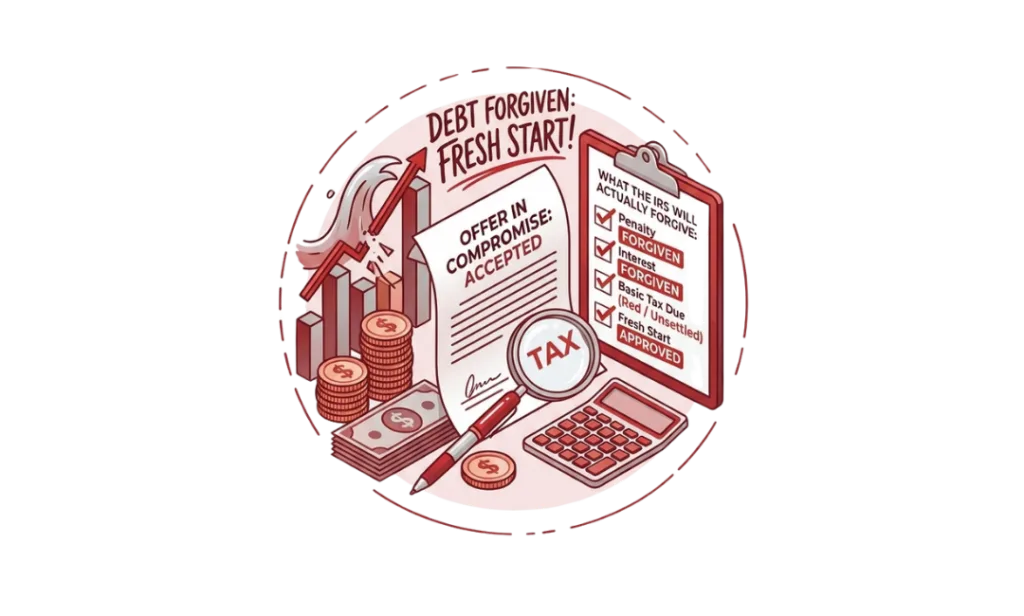
When people refer to “IRS debt forgiveness,” they are usually talking about an Offer in Compromise.
This program allows the IRS to accept less than the total balance if it determines that full payment is unlikely based on your financial condition.
The IRS evaluates what it calls Reasonable Collection Potential (RCP). This calculation considers:
- Monthly income compared to allowable living expenses
- Bank balances and available cash
- Home equity and real estate value
- Retirement accounts and investments
If your offer equals or exceeds what the IRS believes it could reasonably collect from you over time, it may approve the settlement.
Important: You must be current with all required tax filings before submitting an offer. You must also remain compliant for five years after approval, or the settlement can be reversed.
Currently Not Collectible (CNC): Temporary Relief
If paying your tax debt would prevent you from covering necessary living expenses, the IRS may place your account in Currently Not Collectible status.
While in CNC:
- Active collection actions such as levies are generally paused.
- Wage garnishments may stop.
- Interest and penalties continue to accrue.
This status does not erase the debt. It provides breathing room during genuine financial hardship.
Installment Agreements: Structured Repayment
If you cannot pay your balance in full, the IRS may approve a monthly payment plan.
An installment agreement does not reduce the total amount owed, but it can:
- Prevent enforced collection
- Keep your account in good standing
- Provide manageable monthly payments
For many taxpayers, this is the most realistic and practical solution.
When Does IRS Tax Debt Expire?
Under federal law, the IRS generally has 10 years from the date of assessment to collect a tax debt. This is known as the Collection Statute Expiration Date (CSED).
Certain actions can extend this time period, including:
- Submitting an Offer in Compromise
- Filing bankruptcy
- Requesting a Collection Due Process hearing
If the 10-year window expires and no extensions apply, the IRS can no longer legally collect the balance.
Conclusion
The IRS does not randomly forgive tax debt. Every reduction, suspension, or settlement follows defined financial guidelines and legal procedures.
An Offer in Compromise can reduce what you owe, but only when your financial records show that full payment is not realistic. Currently Not Collectible status can temporarily stop collection, but it does not eliminate the balance. Installment agreements provide structure, not forgiveness.
Understanding the differences between these programs is critical before taking action.
Filing the wrong request or submitting incomplete financial information can delay resolution or extend collection time.
If you owe back taxes, the first step is a clear financial analysis. The right strategy depends on your income, assets, compliance history, and long-term stability.
Helpful Resources
- IRS Offer in Compromise Program
- IRS Installment Agreements
- Currently Not Collectible Status
- Internal Revenue Manual
Frequently Asked Questions (FAQ)
Can the IRS really forgive tax debt?
Yes, but only through structured programs like an Offer in Compromise. The IRS reviews your income, assets, and expenses before approving any reduction.
Who qualifies for an Offer in Compromise?
Taxpayers who cannot reasonably pay their full balance through income or assets may qualify. All required returns must be filed, and estimated payments must be current if applicable.
How difficult is it to get approved?
Approval depends on accurate financial disclosure and meeting the IRS’s Reasonable Collection Potential formula. Many applications are rejected because the numbers do not support the offer amount.
Does the IRS forgive penalties and interest?
Certain penalties may be removed through penalty abatement programs. Interest is typically reduced only if related penalties are removed or the underlying tax is adjusted.
What happens if my Offer in Compromise is rejected?
You have the right to appeal within 30 days. An independent appeals officer will review the case.
Does tax debt disappear after 10 years?
In many cases, yes. The IRS generally has 10 years to collect from the date the tax was assessed, though certain actions can extend that timeline.
Can the IRS garnish wages during review?
Collection activity is typically paused while an Offer in Compromise is under review, but interest continues to accrue.
Can the IRS take my house or retirement account?
Seizures are rare but legally possible. Equity in property and retirement accounts may be considered when evaluating settlement eligibility.
Is Currently Not Collectible status permanent?
No. The IRS periodically reviews CNC accounts. If your financial condition improves, collection efforts may resume.
Can self-employed taxpayers qualify?
Yes, but they must be current with required filings and estimated tax payments before the IRS will consider a settlement.

Amro Badran, EA, is the Managing Partner of Badran Tax,
With over 40 years of experience and accreditation as a Federal Enrolled Agent,
Amro Badran and his team of tax professionals specialize in helping individuals and businesses resolve complex IRS & state tax issues and controversies.
Experienced and Trusted Tax Resolution Firm based in New Brunswick, NJ.
Disclaimer
This blog post is provided for educational and informational purposes only.
It does not constitute tax, legal, accounting, or financial advice and should not be relied upon as a substitute for professional counseling tailored to your specific situation.
Always consult a qualified tax advisor or legal professional before making decisions based on this content.
Use of this site or information herein does not create a professional relationship between you and BadranTax LLC or its principals. Any reliance on the material is solely at your own risk.
While we strive to provide accurate, up-to-date information, BadranTax makes no warranties, express or implied, regarding accuracy, completeness, or suitability of the content.
Links to external websites are provided for convenience only. BadranTax does not endorse and is not responsible for the content or practices of third-party sites.
BadranTax and its affiliates expressly disclaim all liability for any actions taken or not taken based on this information.