A balance you cannot pay in full and a search for “IRS tax debt forgiveness” usually go together.
The solution and relief is real, but it is not automatic.
It runs through a handful of specific IRS programs, each with its own eligibility test, and qualifying for one takes more than simply asking.
At a Glance
IRS tax debt forgiveness is real, but it runs through seven specific programs with strict eligibility tests, not one universal application.
- Taxpayers submitted 38,797 offers in compromise in fiscal year 2025. The IRS accepted 5,464.
- There is no “Fresh Start Program” to enroll in. The name refers to permanent rule changes made in 2011 and 2012.
- Penalty relief is changing. The new Automatic Exemption from Penalty replaces First Time Abate for original returns due on or after January 1, 2027.
- Tax debt settled through an offer in compromise is not treated as taxable cancellation-of-debt income.
Who this affects: Individuals, self-employed taxpayers, and business owners carrying unpaid federal tax balances in any state
Updated: August 2026
What IRS Tax Debt Forgiveness Actually Means
There is no single IRS forgiveness program. Instead, the tax code and the IRS’s own procedures provide a set of distinct relief options, and each one is built to address a different financial circumstance. Some reduce the amount you owe. Others pause collection without changing the balance, remove penalties while leaving the underlying tax in place, reassign liability away from a spouse who did not cause it, or allow a debt to expire once the collection period runs out.
Most of these options are governed by a calculation the IRS calls reasonable collection potential, or RCP. RCP represents your equity in assets plus what the IRS believes it could realistically collect from your future income before its collection window closes. The IRS weighs that figure against what you are proposing to pay, and it will generally decline any offer that falls short of what it expects to collect through normal enforcement.
What “Forgiveness” Does and Does Not Cover
- Relief is granted per program and per tax year, never as a blanket write-off of everything you owe.
- Every program requires that all legally required tax returns are filed first.
- Interest and penalties keep running on unpaid balances while you apply.
Timing also matters more than most taxpayers expect. The IRS collection sequence typically moves from a CP14 balance-due notice to a CP504, and then to an LT11 or Letter 1058, the Final Notice of Intent to Levy. That final letter starts a 30-day clock and carries the right to a Collection Due Process hearing. Missing that window forfeits an appeal right that cannot be recovered later.
Why Most IRS Tax Debt Forgiveness Claims Fail
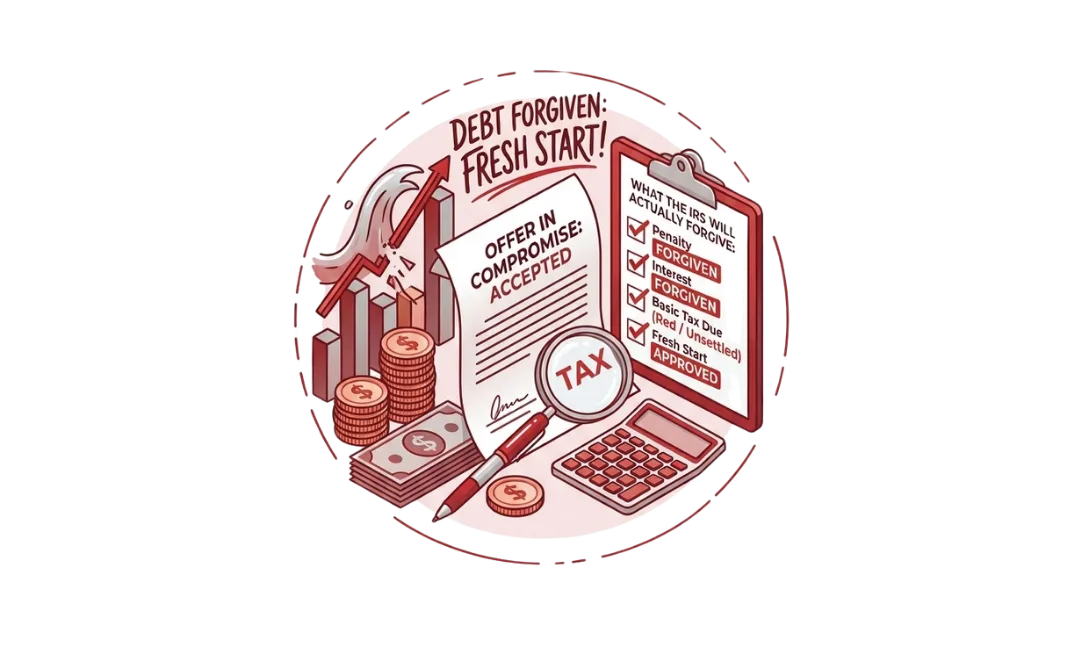
Much of the confusion starts with a name many taxpayers have heard in advertising: the “IRS Fresh Start Program.” No such program exists. The phrase refers to a set of IRS policy changes announced in 2011 and 2012 that raised the payment plan threshold, reduced automatic lien filings on smaller balances, and adjusted how offers in compromise are calculated. Those changes are permanent and are simply how collections work today. There is no Fresh Start application, no enrollment process, and no expiration date, which means any company charging a fee to “enroll” you is charging for something that does not exist.
The second reason claims fail is more mathematical than misleading advertising. An offer in compromise generally must meet or exceed your reasonable collection potential, and the IRS calculates that figure from your own financial statement. Understating an expense raises the number the IRS believes you can pay. Omitting an asset, such as a retirement account, is a common reason an offer is returned rather than evaluated on its merits.
In fiscal year 2025, taxpayers submitted 38,797 offers in compromise. The IRS accepted 5,464 of them, totaling $98.1 million.
That is roughly one accepted offer for every seven submitted. The statistic is not a reason to avoid applying. It is a reason to make sure the financial disclosure supporting the offer is accurate and complete, since the difference between an accepted offer and a returned one usually comes down to the quality of that documentation rather than the severity of the hardship.
⚠ Enforcement Runs While You Apply
Filing an application does not automatically stop every collection action already in motion. If a Final Notice of Intent to Levy has been issued, the 30-day response window runs on its own schedule. Once the IRS certifies a balance above the 2026 seriously delinquent threshold of more than $66,000 to the State Department, your passport can be denied, restricted, or revoked.
Serving Taxpayers in All 50 States
Not Sure Which Program Fits Your Situation?
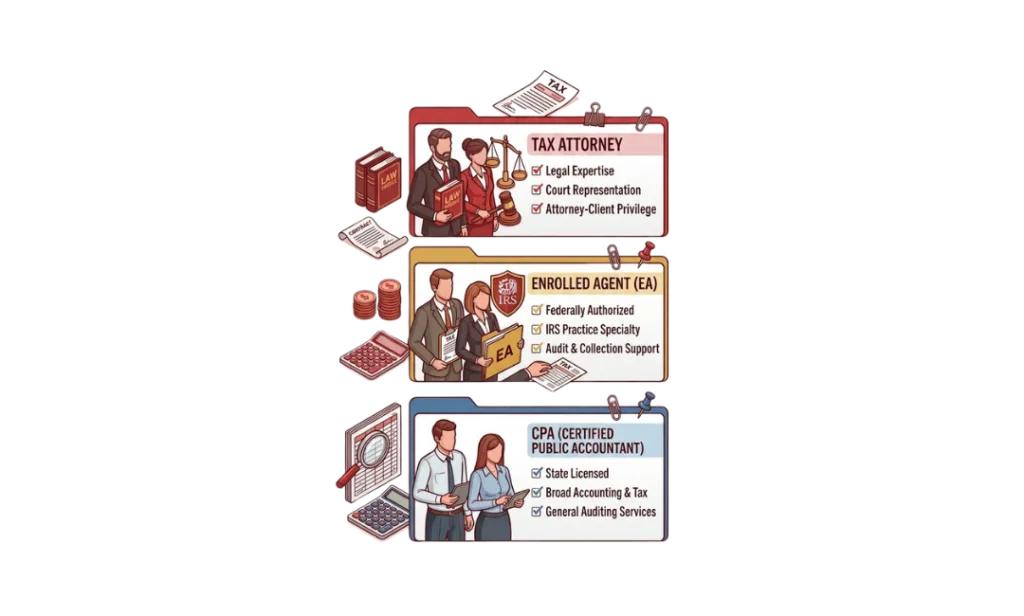
Badran Tax has helped thousands of taxpayers address serious IRS and state tax matters for over 40 years. Our team of Enrolled Agents, CPAs, Tax Attorneys, and Former IRS Agents will review your situation — at no cost.
Schedule Your Free Tax Consultation
or call toll-free: (855) 223-7268
The 7 Programs That Can Reduce or End Your IRS Tax Debt
Each of these answers a different question. The right one depends on what you own, what you earn, and how old the debt is.
1. Offer in Compromise
An offer in compromise settles a federal tax liability for less than the full balance. The IRS recognizes three grounds for accepting one: doubt as to liability, doubt as to collectibility, and effective tax administration. Doubt as to collectibility is the path most taxpayers take, and it means your assets and income fall short of the amount owed.
The application is Form 656 with a Form 433-A (OIC) financial statement. There is a $205 application fee and, for lump-sum offers, a 20% initial payment. Both are waived if you qualify for low-income certification, which is based on adjusted gross income at or below 250% of the federal poverty guidelines for your family size and location. The IRS states that a complete offer investigation can take up to 24 months.
2. Currently Not Collectible Status
Currently Not Collectible, or CNC, is what happens when the IRS agrees that collecting anything right now would leave you unable to cover basic living expenses. Wage garnishments and bank levies stop. The balance does not shrink.
Interest and penalties continue to accrue, refunds are still offset, and the IRS can still file a Notice of Federal Tax Lien. The agency reviews your finances periodically and resumes collection if your income recovers. CNC status still has value, however, because the 10-year collection clock continues to run while the account is in that status.
3. Partial Pay Installment Agreement
A partial pay installment agreement, or PPIA, sets a monthly payment based on what you can actually afford rather than what would fully retire the balance. Any amount still outstanding when the collection statute expires is no longer collectible.
This requires a full financial disclosure and IRS approval, and the agency reviews the arrangement periodically. For comparison, a standard long-term payment plan is available to individuals who owe $50,000 or less in combined tax, penalties, and interest and have filed all required returns. A short-term plan covers balances under $100,000. Neither of those reduces what you owe.
4. Penalty Relief, Including the New Automatic Exemption
When penalties make up a large share of a balance, removing them can meaningfully reduce what is owed. Two paths are available. Reasonable cause relief applies to serious illness, natural disaster, and similar circumstances outside a taxpayer’s control. Administrative relief applies to taxpayers with a clean recent compliance record, and that second path recently changed.
✓ Automatic Exemption from Penalty Replaces First Time Abate
On July 8, 2026, the IRS announced the Automatic Exemption from Penalty, or AEP, which grants relief without a request. It applies to eligible original returns beginning with tax year 2025 and 2026 quarterly returns, covering failure-to-file, failure-to-pay, and failure-to-deposit penalties. Taxpayers generally qualify by having filed and paid on time for the prior three years, or 12 consecutive quarters for quarterly returns. First Time Abate remains available by request during the transition and is replaced by AEP for original returns due on or after January 1, 2027.
5. Innocent Spouse Relief
If a joint return created a balance because of your spouse’s unreported income or improper deductions, you may qualify to be released from that portion of the liability. You request it on Form 8857, and the IRS evaluates all three types of relief automatically: traditional innocent spouse relief, separation of liability, and equitable relief.
The filing deadlines differ by type of relief. Traditional relief and separation of liability generally must be requested within two years of the IRS’s first collection activity against you. Equitable relief is not subject to that two-year limit, which the IRS removed in 2011, so it often remains available after the other two options have closed. The IRS is required by law to notify your spouse or former spouse once a request is filed.
6. Expiration of the Collection Statute
The IRS generally has 10 years from the date a tax is assessed to collect it. That date is the Collection Statute Expiration Date, or CSED. When it passes, the liability is no longer legally enforceable.
That 10-year period is rarely a straight countdown. It pauses while an offer in compromise is pending, during a Collection Due Process hearing, through a bankruptcy case, and for periods spent outside the United States. Each pause extends the CSED, which is why the expiration date on an account transcript rarely matches a simple 10-year count from the assessment date.
7. Bankruptcy Discharge
Some older income tax debt can be discharged in bankruptcy under what practitioners call the 3-2-240 rule. The return must have been due at least three years before the filing, actually filed by you at least two years before, and assessed at least 240 days before.
Payroll and trust fund taxes are not dischargeable. Neither is any liability tied to a fraudulent return or willful evasion. A substitute return the IRS prepared for you does not count as a filed return for this test, and this detail is the one most often overlooked.
| Program | Reduces the Balance? | Core Test |
|---|---|---|
| Offer in Compromise | Yes | Offer meets or exceeds reasonable collection potential |
| Currently Not Collectible | No, pauses collection | Payment would prevent basic living expenses |
| Partial Pay Installment Agreement | Yes, over time | Full repayment impossible within the collection period |
| Penalty Relief / AEP | Penalties only | Clean compliance history or documented reasonable cause |
| Innocent Spouse Relief | Yes, your share | Liability came from a spouse’s items you did not know about |
| Collection Statute Expiration | Yes, if it runs out | 10 years from assessment, adjusted for periods that paused it |
| Bankruptcy Discharge | Sometimes | Income tax meeting the 3-2-240 timing rules |
Who Actually Qualifies: Three Common Situations
Program eligibility becomes clearer when applied to an actual financial picture. The following examples illustrate how these programs tend to fit different circumstances.
Self-Employed Taxpayer With Unfiled Returns
A self-employed taxpayer with three years of unfiled returns and roughly $60,000 assessed after the IRS prepared substitute returns has no home equity, minimal assets, and current income that barely covers living expenses. An offer in compromise may ultimately fit this situation, but filing the missing returns comes first, since the IRS will not evaluate an offer from a taxpayer who is not in filing compliance. Currently Not Collectible status often provides breathing room while returns are being prepared.
Homeowner With Equity but Limited Cash Flow
A W-2 employee who owes $85,000 and holds $200,000 in home equity typically will not have an offer in compromise accepted, because the IRS counts that equity toward reasonable collection potential. A standard payment plan or a partial pay installment agreement is usually the more realistic path. Penalty relief can still meaningfully reduce the total balance in cases like this.
Taxpayer Held Liable for a Former Spouse’s Errors
A taxpayer divorced four years ago may still be facing a $40,000 assessment tied to a joint return filed during the marriage, where the liability originated from a business the former spouse operated. Innocent spouse relief is the appropriate starting point. If the two-year window for traditional relief has closed, equitable relief may still be available, since it carries no fixed deadline.
What to Do Now
Before choosing a program, it helps to confirm the facts the IRS already has on file.
- Pull your account transcripts. They show assessment dates, the balance by year, and the events that paused your collection statute.
- File every missing return. No relief program moves forward without filing compliance, and self-prepared returns almost always beat IRS-prepared substitute returns.
- Read the notice for its deadline, not its number. An LT11 or Letter 1058 starts a 30-day clock for a Collection Due Process hearing.
- Run the RCP math before you apply. A rejected offer costs you the $205 fee, months of waiting, and any payments already submitted.
- Check current-year compliance. Withholding or estimated payments must be current, or an accepted arrangement can default.
- Decline any “enrollment fee.” Since the Fresh Start Program does not exist as an application, no legitimate firm charges a fee to enroll in it.
These programs also interact with one another. An offer in compromise, for example, pauses the collection statute while it is under review, which can extend the life of a debt that was otherwise close to expiring. Sequencing matters as much as selecting the right program.
The team at Badran Tax helps individuals and businesses work through IRS tax debt forgiveness options across all 50 states. If wage garnishment or a bank levy is already in motion, our levy and garnishment resolution team can review where your case stands and what timelines still apply.
Frequently Asked Questions
Can the IRS really forgive tax debt?
Yes, through specific programs including an offer in compromise, partial pay installment agreement, innocent spouse relief, penalty relief, and expiration of the collection statute. Each has its own eligibility test, and none of them forgives a balance automatically.
What is the IRS Fresh Start Program?
It is a marketing name, not an application. Fresh Start refers to IRS policy changes from 2011 and 2012 that expanded access to payment plans and offers in compromise. Those changes are permanent, and there is nothing to enroll in.
How much will the IRS settle for?
There is no standard percentage. The IRS compares your offer to your reasonable collection potential, which is your asset equity plus expected future income. If it can collect more than you are offering, it will decline.
Is forgiven IRS tax debt taxable income?
No. Federal tax debt compromised through an offer in compromise is not treated as cancellation-of-debt income, and the IRS does not issue a Form 1099-C for it. Commercial debt settled with a private creditor follows different rules.
Does IRS tax debt go away after 10 years?
Generally the IRS has 10 years from assessment to collect, after which the debt is no longer enforceable. Pending offers, Collection Due Process hearings, bankruptcy, and time spent abroad all pause that clock, so the actual date is often later than 10 years.
Can the IRS take my passport over back taxes?
The IRS can certify a seriously delinquent tax debt to the State Department, which may then deny, restrict, or revoke a passport. For 2026 the threshold is more than $66,000, and certification also requires a filed lien with lapsed appeal rights or an issued levy.
Do I have to file old returns before applying for relief?
Yes. Filing compliance is a threshold requirement for every IRS resolution program. An application submitted with unfiled returns is generally returned without consideration.
What is the easiest IRS relief to qualify for?
Penalty relief is typically the most accessible, particularly for taxpayers with a clean recent compliance record. Under the new Automatic Exemption from Penalty, eligible taxpayers receive it without submitting a request.
Can I apply for IRS tax debt forgiveness myself?
You can. The forms and the pre-qualifier tool are free on IRS.gov. The risk is that a financial statement built incorrectly produces a higher reasonable collection potential than your situation actually supports, and a returned offer costs time you may not have.
Bottom Line
IRS tax debt forgiveness exists, but it takes the form of several narrowly defined programs rather than one broad remedy. Which one applies depends on filing history, asset equity, monthly cash flow, and how old the assessment is.
The most costly mistake is usually not selecting the wrong program. It is delaying a decision while a Final Notice of Intent to Levy runs its course, a passport certification moves forward, or an unfiled return continues to block every available option. Enforcement timelines do not pause while a taxpayer weighs the alternatives.
If you are weighing IRS tax debt forgiveness options, Amro Badran, EA, Managing Partner of Badran Tax, and the firm’s licensed tax professionals are available to help. With over 40 years of experience resolving IRS and state tax problems, and a team that includes Enrolled Agents, CPAs, Tax Attorneys, and Former IRS Agents, Badran Tax works with taxpayers in all 50 states to identify options and pursue resolution.
40+ Years of IRS & State Tax Resolution
Ready to Resolve Your Tax Problem?
Schedule a free, no-obligation consultation with our licensed tax professionals. We’ll review your situation, explain your options, and help you find a path forward — no matter how complex the issue.
Schedule Your Free Tax Consultation
or call toll-free: (855) 223-7268 | Monday–Friday, 9AM–5PM EST
Sources & Helpful Resources
- IRS: Offer in Compromise
- IRS Topic No. 204: Offers in Compromise
- IRS Form 656-B: Offer in Compromise Booklet
- IRS: Payment Plans and Installment Agreements
- IRS: Automatic Exemption from Penalty Announcement (July 8, 2026)
- IRS: Administrative Penalty Relief
- IRS: Innocent Spouse Relief
- IRS: Revocation or Denial of Passport for Unpaid Taxes
- Taxpayer Advocate Service

Amro Badran, EA, is the Managing Partner of Badran Tax,
With over 40 years of experience and accreditation as a Federal Enrolled Agent,
Amro Badran and his team of tax professionals specialize in helping individuals and businesses resolve complex IRS & state tax issues and controversies.
Experienced and Trusted Tax Resolution Firm based in New Brunswick, NJ.
Disclaimer
This blog post is provided for educational and informational purposes only.
It does not constitute tax, legal, accounting, or financial advice and should not be relied upon as a substitute for professional counseling tailored to your specific situation.
Always consult a qualified tax advisor or legal professional before making decisions based on this content.
Use of this site or information herein does not create a professional relationship between you and BadranTax LLC or its principals. Any reliance on the material is solely at your own risk.
While we strive to provide accurate, up-to-date information, BadranTax makes no warranties, express or implied, regarding accuracy, completeness, or suitability of the content.
Links to external websites are provided for convenience only. BadranTax does not endorse and is not responsible for the content or practices of third-party sites.
BadranTax and its affiliates expressly disclaim all liability for any actions taken or not taken based on this information.