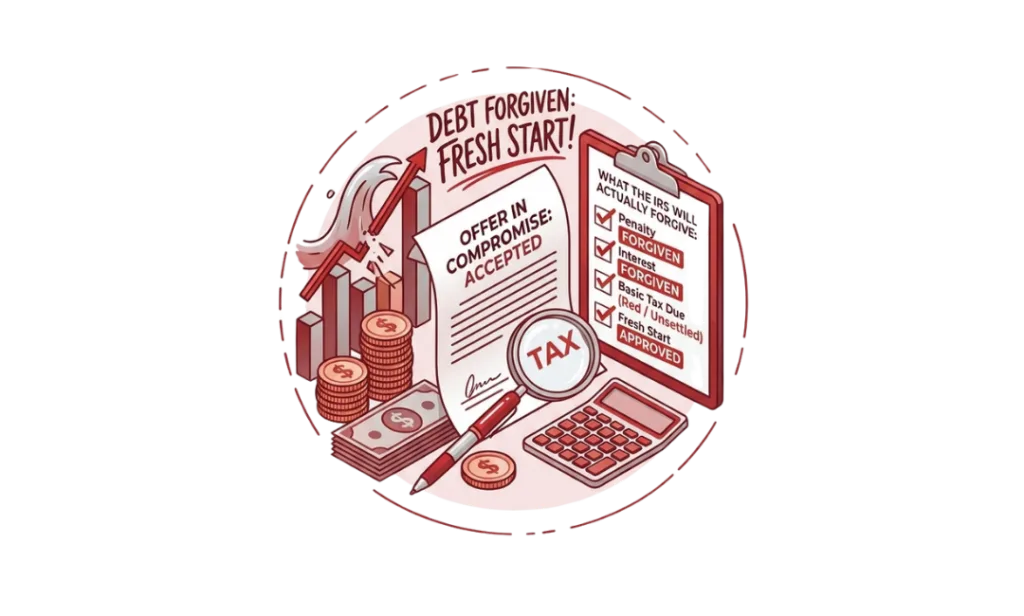

Offer in Compromise (OIC) is the one IRS program that can settle tax debt for less than you owe.
But it is also one of the most misunderstood and heavily marketed programs in tax resolution. In this post, we break down the real rules, who actually qualifies, and how to avoid “pennies on the dollar” traps.
Podcast Feature: The Truth About IRS Offer in Compromise
(Avoid Penny-on-the-Dollar Scams)
This article is based on our podcast episode: “The IRS Offer in Compromise Truth for Taxpayers to Avoid Penny on Dollar Scams” featuring Christopher Nichols, Director of Tax Resolution at BadranTax.
About our guest: Chris spent 24 years with the IRS, including time as a Collection Revenue Officer and an Appeals Settlement Officer in New Jersey.
Today, he helps taxpayers identify red flags, avoid bad filings, and build stronger OIC submissions when it truly makes sense.
What Is an IRS Offer in Compromise?
When the IRS is trying to collect unpaid taxes, there are generally three core paths discussed in the episode:
- Installment Agreement (monthly payment plan)
- Currently Not Collectible (CNC) (collection paused due to hardship)
- Offer in Compromise (OIC) (the only option that can settle for less than the full amount owed)
An Offer in Compromise is not a shortcut.
It is a formal settlement process where the IRS reviews your financial reality and decides whether accepting less is reasonable.

“Settle for Pennies on the Dollar” Is Usually Misleading
One of the biggest takeaways from the conversation is this: many people file an OIC when they are not good candidates.
That can waste time, cost money, and in some cases create bigger problems later.
Reality check: OIC is typically approved when the IRS believes full collection is unlikely within the legal collection window, based on your income, expenses, and assets.
If your situation does not support a compromise, the IRS may still expect full payment through a plan, enforced collection, or other remedies.
When an Offer in Compromise Makes Sense
In the episode, the most common OIC type discussed is Doubt as to Collectability.
That means you owe a balance that you realistically cannot pay in full, even with a long-term plan.
Main Types of Offers
- Doubt as to Collectability: You cannot pay the full balance based on your financials.
- Doubt as to Liability: You believe the amount assessed is wrong, and you can support that with evidence.
- Effective Tax Administration (ETA): You could pay, but doing so would create serious hardship or raise public policy concerns (often tied to age, illness, disability, or special circumstances).
OIC Approval Rates: What to Expect
Chris explains that approval rates vary and a common rule-of-thumb is that only a minority of offers are accepted. That is why screening matters before filing.
Practical takeaway: A strong OIC is built on accurate financials, proper documentation, and a realistic offer amount tied to the IRS calculation.
How the IRS Decides Your Offer Amount
The IRS uses a method often referred to as Reasonable Collection Potential (RCP). In simple terms, it asks:
- How much can you pay each month after allowable living expenses?
- What value do your assets represent (cash, bank balances, home equity, retirement, vehicles, investments)?

Income Minus Allowable Expenses
The IRS compares your monthly income to allowable expenses. If there is money left over each month, the IRS may multiply that figure based on the payment option used in the offer.
Assets: Home Equity, Bank Accounts, Retirement, Vehicles
Assets matter a lot. If you have significant equity in a home or liquid assets, it can be harder to qualify because the IRS may view those assets as available to pay the debt.
Tip from the episode: The IRS focuses on realistic values. For many personal items, it is closer to “garage sale value” than what you paid retail.
Can You File an OIC If You Have Equity in Your Home?
Yes, you can. But as discussed in the episode, it is usually more challenging.
The IRS may include available equity in the offer calculation because the government does not want to remove a lien and then watch the taxpayer sell the home later without collecting what it could have collected.
When Home Equity May Be Treated Differently
There are situations where equity is not easily accessible (for example, you cannot get approved for a home equity loan or line of credit). In those cases, supporting documentation may matter, such as a lender denial letter.
The 10-Year IRS Collection Rule and a Big OIC Issue
The IRS generally has 10 years to collect a tax debt from the date it is assessed.
In the episode, Chris emphasizes a key point taxpayers often miss:
Filing an Offer in Compromise can pause the collection clock while the offer is being reviewed.
If the offer is ultimately rejected (or appealed), that paused time may be added back, giving the IRS more time to collect.

Bottom line: An OIC should not be filed just to “buy time.” The strategy and timing matter.
Compliance Requirements: What You Must Do Before Filing
A common reason offers fail is compliance. In the episode, Chris highlights that the IRS will check whether you are current with required filings and whether you are staying current going forward.
- File required returns (often the last several years, depending on your situation)
- Stay current with withholding or estimated tax payments if required
- Avoid new tax debt while the offer is pending
Important: An accepted offer typically comes with ongoing compliance expectations. Falling out of compliance later can create serious problems.
Conclusion
An Offer in Compromise can be a legitimate path to settling tax debt for less than you owe, but it is not a guaranteed outcome and it is not a fit for everyone.
The IRS will measure your ability to pay using rules that focus on income, allowable expenses, and asset value.
If you are considering an OIC, the best first step is clarity.
Understand whether you qualify before you file, avoid marketing claims that sound too easy, and make sure the numbers you submit can be supported.
Want the full breakdown in plain English? Watch the episode and then reach out if you want a professional review of your situation.
Helpful Resources
- IRS: Offer in Compromise (Official Program Page)
- IRS Offer in Compromise Pre-Qualifier Tool
- IRS Publication 594: The IRS Collection Process
- IRS Newsroom (Official Updates)
Frequently Asked Questions (FAQ)
What is the difference between an IRS payment plan and an Offer in Compromise?
An installment agreement is a monthly payment plan where you pay the balance over time. An Offer in Compromise is a settlement request to pay less than the full amount owed, but only if the IRS agrees you cannot reasonably pay in full.
How do I know if I qualify for an Offer in Compromise?
Qualification depends on your income, allowable expenses, and assets. A quick starting point is the IRS Offer in Compromise Pre-Qualifier tool, but complex cases should be reviewed professionally.
How long does the IRS take to review an Offer in Compromise?
OIC reviews often take months and can vary by case complexity and IRS workload. Delays are common if documents are missing or the IRS needs clarification.
Can I file an OIC if I own a home?
Yes, but home equity can raise the offer amount or make acceptance harder. The IRS may include available equity in its calculation unless there are documented reasons the equity is not accessible.
What is “Reasonable Collection Potential” (RCP)?
RCP is the IRS’s method of estimating what it could collect from you through monthly payments and assets. Your offer generally needs to match or exceed the IRS’s RCP calculation to be considered acceptable.
Do “pennies on the dollar” offers really happen?
They can, but typically in cases where the taxpayer has little to no ability to pay and few assets. Advertising often oversimplifies this. Many taxpayers do not qualify for a very low settlement.
Does filing an Offer in Compromise stop IRS collection?
Filing an OIC can pause certain collection actions while the offer is pending, but rules vary by situation. Also, the collection statute can be paused during the review, which can extend the time the IRS has to collect.
Can I apply for an Offer in Compromise if I am self-employed?
Yes. The IRS will review your business income and expenses along with your personal financials. Clean bookkeeping and current estimated payments can make a major difference.
What happens if the IRS rejects my Offer in Compromise?
You may be able to appeal within the IRS deadline listed in the rejection letter. Rejections also come with a worksheet showing the IRS’s calculation, which can help identify disputes or corrections.
Can an accepted Offer in Compromise be reversed later?
If you fail to follow the terms, including staying compliant with filing and payment requirements afterward, the IRS can treat the offer as defaulted and collections may resume. This is one reason ongoing compliance is critical.
What should I watch out for when hiring a company for an Offer in Compromise?
Be cautious of guarantees, high-pressure sales tactics, and promises that sound unrealistic. A trustworthy provider should review your financials first and explain alternatives if OIC is not the best fit.

Amro Badran, EA, is the Managing Partner of Badran Tax,
With over 40 years of experience and accreditation as a Federal Enrolled Agent,
Amro Badran and his team of tax professionals specialize in helping individuals and businesses resolve complex IRS & state tax issues and controversies.
Experienced and Trusted Tax Resolution Firm based in New Brunswick, NJ.
Disclaimer
This blog post is provided for educational and informational purposes only.
It does not constitute tax, legal, accounting, or financial advice and should not be relied upon as a substitute for professional counseling tailored to your specific situation.
Always consult a qualified tax advisor or legal professional before making decisions based on this content.
Use of this site or information herein does not create a professional relationship between you and BadranTax LLC or its principals. Any reliance on the material is solely at your own risk.
While we strive to provide accurate, up-to-date information, BadranTax makes no warranties, express or implied, regarding accuracy, completeness, or suitability of the content.
Links to external websites are provided for convenience only. BadranTax does not endorse and is not responsible for the content or practices of third-party sites.
BadranTax and its affiliates expressly disclaim all liability for any actions taken or not taken based on this information.