
Owing taxes every year rarely comes down to bad luck.
It’s usually a structural gap between what you paid the IRS and what you actually owed, compounding quietly.
IRS interest on 2026 underpayments now runs 7% annually, compounded daily.
Closing the cycle means two things:
- Fix your withholding before September 15
- Resolve what’s already owed.
At a Glance
Owing the IRS every April usually comes down to a payment gap you can close now, and if back tax debt has already built up, IRS programs exist to resolve it.
- Q3 estimated tax payments are due September 15, 2026
- IRS underpayment interest is 7% annually, compounded daily, for Q3 2026
- Safe harbor protection means paying 100% of last year’s tax (110% if you earned over $150,000) or 90% of this year’s
- Installment agreements, penalty abatement, and Offer in Compromise are available for eligible taxpayers with existing IRS debt
Who this affects: Self-employed taxpayers, freelancers, gig workers, and anyone with under-withheld income
Updated: August 2026
Why You Keep Owing the IRS Every April
Freelance income, a side business, investment gains, or a second job usually isn’t taxed automatically the way W-2 wages are.
Unless you’re actively setting money aside for it, the gap between what’s withheld and what you’ll actually owe grows all year, and you don’t notice until you file.
That gap doesn’t sit still.
The IRS charges interest on any underpaid tax, recalculated every quarter and compounded daily.
For the quarter covering the September 15 deadline, the rate sits at 7% annually, up from 6% in the spring.
A $5,000 shortfall left unpaid for a full year costs roughly $360 in interest alone at the current 7% rate, before any underpayment penalty is added on top.
None of this requires a crisis to happen. It requires two ordinary decisions: getting this year’s payments right, and dealing honestly with whatever’s already on the books from prior years.
Skip either one and the cycle just resets next April.
Beat the September 15 Estimated Tax Deadline
The third-quarter estimated payment is due September 15, 2026.
It covers income earned from June through August, and it’s the one deadline most people forget exists until the IRS sends a notice about it months later.
You don’t need to calculate your exact 2026 liability to avoid the underpayment penalty. You need to land inside one of two safe harbor thresholds: pay at least 90% of what you’ll owe this year, or 100% of what you owed last year. If your 2025 adjusted gross income was over $150,000, that prior-year threshold rises to 110%.
⚠ Miss September 15 and Interest Starts Immediately
Any shortfall from the third quarter begins accruing interest at 7% annually, compounded daily, the moment the deadline passes. The rate resets again October 1 and can move in either direction.
2026 Safe Harbor Thresholds
- Pay 90% of your total 2026 tax liability, or
- Pay 100% of your total 2025 tax liability (110% if your 2025 AGI exceeded $150,000)
- Hitting either threshold through withholding plus estimated payments avoids the penalty, even if a balance remains at filing.
Calculating that 90% figure is harder this year than usual.
Recent tax law changes touched more than 100 provisions, and the National Taxpayer Advocate has noted that while many of the changes favor taxpayers, they come with income thresholds and eligibility rules that complicate a same-year estimate.
If you’re unsure which safe harbor applies to you, the 100%-of-last-year path is usually the simpler one to verify on your own.
- Submit your Q3 payment through Form 1040-ES. Pay online through your IRS Online Account or mail the voucher before September 15.
- Adjust your W-4 for the rest of the year. A revised W-4 pulls more tax out of each remaining paycheck, spreading the correction across your last few pay periods instead of one lump payment.
- Maximize pre-tax contributions before December 31. Money moved into a traditional 401(k), IRA, SEP-IRA, or HSA reduces the income your safe harbor calculation is based on.
Fixing 2026 doesn’t erase what you might already owe from prior years.
That’s a separate problem, and it needs a separate plan.
Serving Taxpayers in All 50 States
Not Sure Which Safe Harbor Rule Applies to You?
Badran Tax has helped thousands of taxpayers address serious IRS and state tax matters for over 40 years. Our team of Enrolled Agents, CPAs, Tax Attorneys, and Former IRS Agents will review your situation — at no cost.
Schedule Your Free Tax Consultation
or call toll-free: (855) 223-7268
Already Behind? How Back Tax Debt Gets Resolved
Unfiled returns and unpaid balances don’t stay quiet.
The IRS can file a return on your behalf using only the income it has on record, with no deductions applied, which almost always produces a bigger bill than filing yourself would.
From there, the agency can move to wage garnishment, a bank levy, or a federal tax lien on your property.
A wage garnishment means a chunk of your next paycheck doesn’t show up.
A bank levy means funds already sitting in your account get taken to cover the balance.
Neither happens without notice first, but the notices are easy to miss or misread, and by the time most people call for help, collection action is already scheduled.
✓ Relief Programs Exist for Eligible Taxpayers
None of this is necessarily permanent. Several IRS programs are built specifically for taxpayers who can’t pay in full, and a licensed tax professional can help determine which one, if any, fits your situation.
| Program | What It Does | Best Fit For |
|---|---|---|
| Penalty Abatement | Removes penalties, not the underlying tax, for reasonable cause or first-time compliance | A clean prior filing history or a documented hardship like illness or disaster |
| Installment Agreement | Spreads the balance into monthly payments, often over several years | Taxpayers who can pay over time but not all at once |
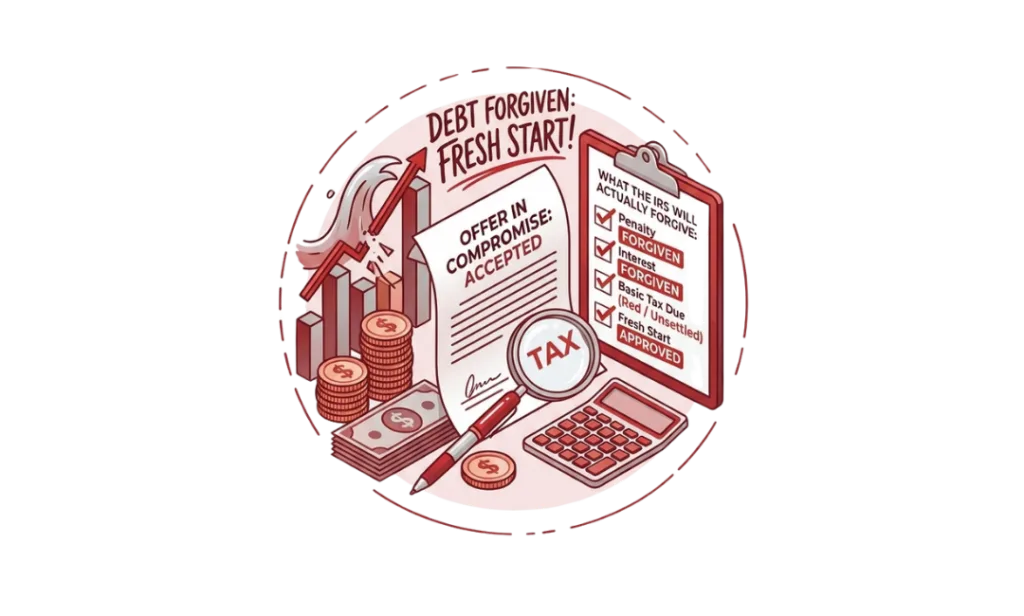
| Offer in Compromise | Settles the debt for less than owed, based on what the IRS could realistically collect | Taxpayers whose income and assets fall well short of the full balance |
| Currently Not Collectible | Pauses active collection while the balance remains unpaid | Taxpayers facing genuine short-term financial hardship |
Outcomes vary based on your specific situation, and not every taxpayer qualifies for every program.
An Enrolled Agent or tax attorney can review your income, assets, and filing history to identify which path applies before you submit anything to the IRS.
The team at Badran Tax helps individuals and businesses navigate back tax debt across all 50 states.
A free consultation can clarify exactly where you stand and what options may be available in your situation.
Why Professional Representation Matters Right Now
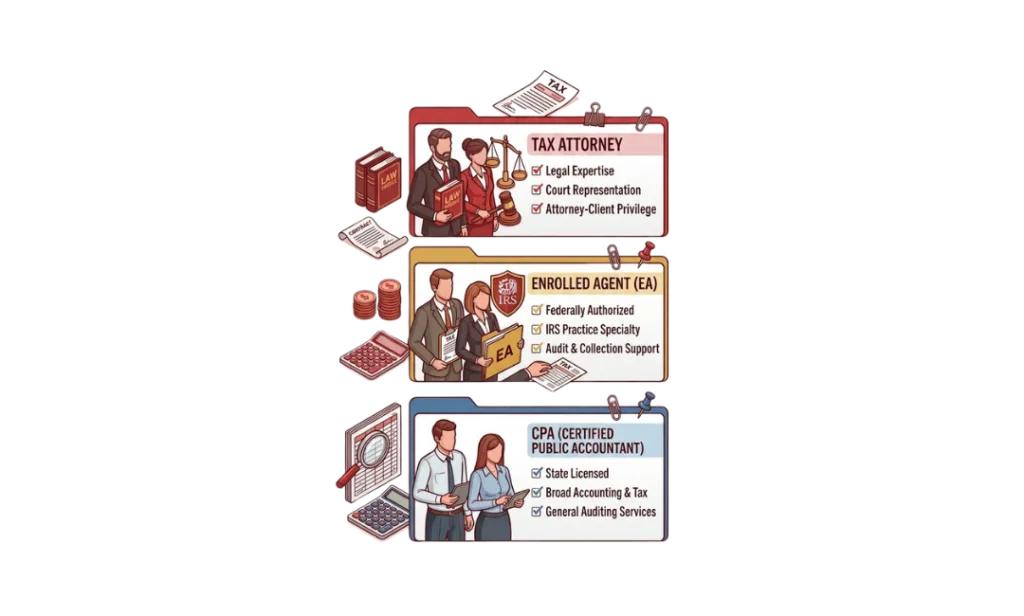
An Enrolled Agent is federally licensed to represent taxpayers before the IRS in all 50 states, the only credential built specifically for that purpose.
That matters most when you’re negotiating directly with the agency instead of just filing paperwork and hoping for the best.
It also matters because the IRS itself is harder to reach right now than it was a year ago.
A Government Accountability Office report released this month found the agency’s return-processing staff had shrunk by 18% year over year, with average processing time for paper returns nearly doubling.
Fewer staff also means longer hold times and slower replies to correspondence, exactly the kind of delay that turns a manageable notice into a missed deadline.
Waiting on hold isn’t a tax strategy.
The strongest approach treats both problems as one.
Fixing your 2026 withholding without addressing an existing balance just means paying down two things at once with no plan.
Resolving old debt without correcting current withholding means you’ll likely be back here again next April.
A coordinated plan does both at the same time.
Frequently Asked Questions
What happens if I miss the September 15 estimated tax deadline?
Interest starts accruing immediately on the shortfall, currently 7% annually and compounded daily. If you also fall short of the safe harbor thresholds for the year, the IRS may add an underpayment penalty when you file.
How do I know if I qualify for safe harbor protection?
You’re protected if your withholding and estimated payments for the year equal at least 90% of your 2026 tax liability, or 100% of your 2025 liability (110% if your 2025 AGI was over $150,000). Most people find the prior-year threshold easier to verify with confidence.
Will the IRS waive penalties if I have reasonable cause?
Penalty abatement is available for taxpayers who can show reasonable cause, such as serious illness, a natural disaster, or an IRS error, or for first-time compliance issues. It removes penalties, not the underlying tax owed, and approval depends on the specific facts of your case.
Can I set up a payment plan if I can’t pay my full tax bill?
Yes. Short-term plans cover balances under $100,000 paid within 180 days, and long-term installment agreements are available for balances under $50,000 paid over a longer period. Interest keeps accruing, but the failure-to-pay penalty rate is cut in half once a plan is approved.
Does an Offer in Compromise actually reduce what I owe?
It can, but only if the IRS agrees the offer reflects the most it could realistically collect from your income and assets. Most applications aren’t accepted at the amount originally proposed, so an accurate calculation before applying matters more than the offer itself.
What’s the difference between an installment agreement and Currently Not Collectible status?
An installment agreement pays down the balance over time. Currently Not Collectible status pauses collection entirely because your current finances can’t support any payment, but the balance remains and continues accruing interest until your situation improves.
Can adjusting my W-4 now fix an underpayment problem before year-end?
It can help close the gap for the rest of 2026, since withholding is treated as if it were paid evenly across the year regardless of when it’s actually withheld. It won’t retroactively fix Q1 through Q3, but combined with a Q3 payment it can bring you back inside the safe harbor.
Do unfiled prior-year returns affect my ability to resolve current tax debt?
Yes. The IRS generally won’t approve an installment agreement or Offer in Compromise until all required returns are filed. Getting current on filing is usually the first step, not an optional one.
Bottom Line
The cycle of owing every April almost always traces back to the same gap: what’s being withheld or paid quarterly versus what’s actually owed.
Left alone, that gap doesn’t shrink. It compounds at whatever rate the IRS is charging that quarter, currently 7%, and it can trigger collection action if a prior balance goes unaddressed long enough.
Closing it takes two moves happening together: getting the September 15 payment right, and dealing honestly with anything still owed from before.
Neither one fixes the other on its own.
If you’re navigating an underpayment problem, back tax debt, or both, Amro Badran, EA, Managing Partner of Badran Tax, and the firm’s licensed tax professionals are available to help. With over 40 years of experience resolving IRS and state tax problems, and a team that includes Enrolled Agents, CPAs, Tax Attorneys, and Former IRS Agents, Badran Tax works with taxpayers in all 50 states to identify options and pursue resolution.
40+ Years of IRS & State Tax Resolution
Ready to Resolve Your Tax Problem?
Schedule a free, no-obligation consultation with our licensed tax professionals. We’ll review your situation, explain your options, and help you find a path forward — no matter how complex the issue.
Schedule Your Free Tax Consultation
or call toll-free: (855) 223-7268 | Monday–Friday, 9AM–5PM EST
Sources & Helpful Resources
- IRS: Estimated Taxes and Safe Harbor Rules
- IRS: Internal Revenue Bulletin 2026-22 (Q3 2026 Interest Rates)
- IRS: Payment Plans and Installment Agreements
- IRS: Offer in Compromise
- IRS: Penalty Relief for Reasonable Cause
- GAO: 2026 Filing Season — Preliminary Observations on IRS Performance

Amro Badran, EA, is the Managing Partner of Badran Tax,
With over 40 years of experience and accreditation as a Federal Enrolled Agent,
Amro Badran and his team of tax professionals specialize in helping individuals and businesses resolve complex IRS & state tax issues and controversies.
Experienced and Trusted Tax Resolution Firm based in New Brunswick, NJ.
Disclaimer
This blog post is provided for educational and informational purposes only.
It does not constitute tax, legal, accounting, or financial advice and should not be relied upon as a substitute for professional counseling tailored to your specific situation.
Always consult a qualified tax advisor or legal professional before making decisions based on this content.
Use of this site or information herein does not create a professional relationship between you and BadranTax LLC or its principals. Any reliance on the material is solely at your own risk.
While we strive to provide accurate, up-to-date information, BadranTax makes no warranties, express or implied, regarding accuracy, completeness, or suitability of the content.
Links to external websites are provided for convenience only. BadranTax does not endorse and is not responsible for the content or practices of third-party sites.
BadranTax and its affiliates expressly disclaim all liability for any actions taken or not taken based on this information.