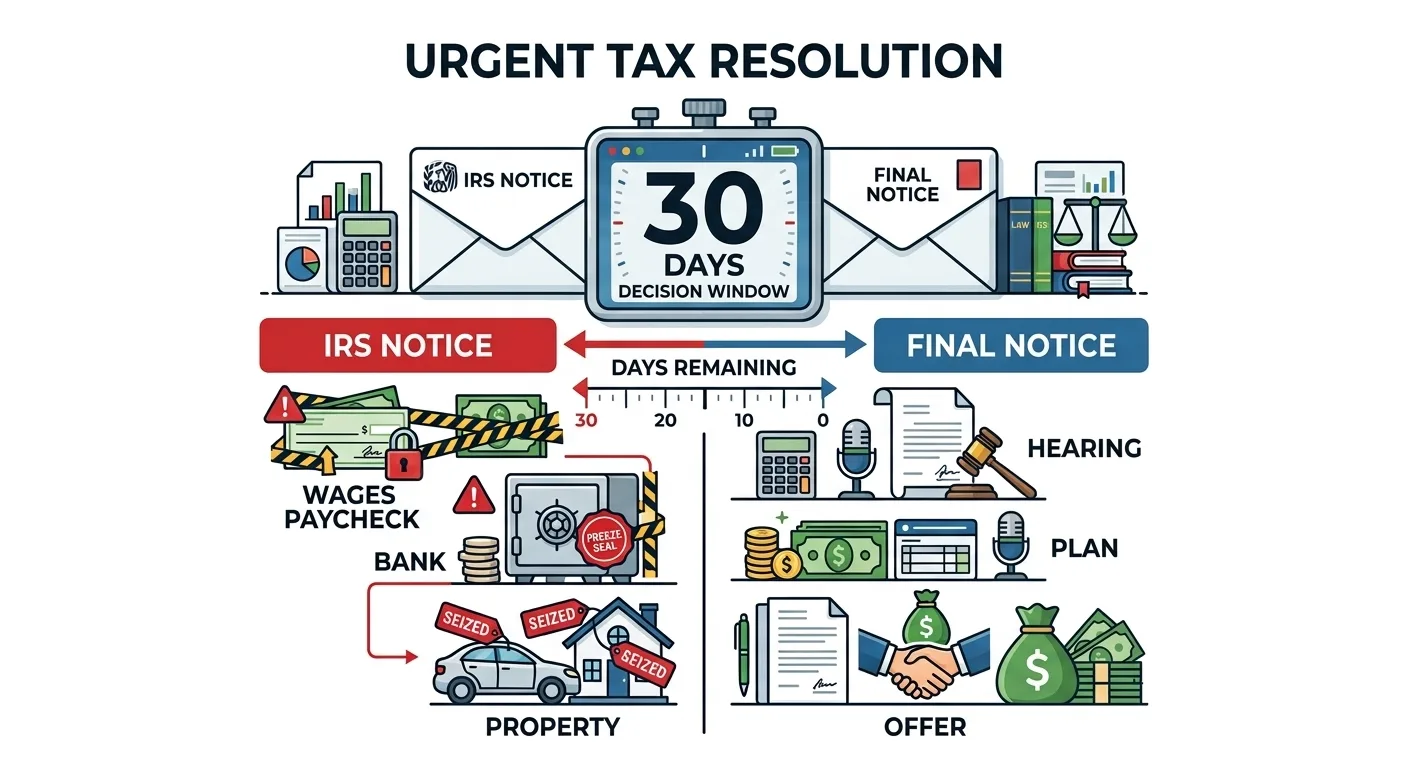
IRS Letter 1058 and Notice LT11 are the final notice the IRS must send before it can levy your wages, bank accounts or other property.
You have 30 days from the notice date to request a Collection Due Process hearing on Form 12153.
A timely request pauses the levy while IRS Appeals reviews your notice and your options.
At a Glance
Letter 1058 and LT11 are the IRS’s Final Notice of Intent to Levy, and they open a 30-day window to request a hearing before an independent Appeals officer.
- The deadline is 30 days from the notice date. Your letter prints the last day.
- A timely Form 12153 generally pauses the levy and the 10-year collection clock.
- Miss the 30 days and you can still ask for an equivalent hearing within one year, with fewer protections.
- After a timely hearing, you have 30 days to take the Appeals decision to Tax Court.
Who this affects: Individuals and business owners holding an IRS Letter 1058, LT11 or CP90
In this article
What Is IRS Letter 1058 or LT11?
Both are the IRS’s Final Notice of Intent to Levy and Notice of Your Right to a Hearing. A levy is the legal seizure of money or property to pay a tax debt. It can reach a paycheck, a bank account, retirement funds, rental income or property you own, according to the IRS levy overview.
The two versions carry the same legal weight. LT11 generally comes from the IRS’s automated collection system. Letter 1058 generally comes from a revenue officer, an IRS employee assigned to your case in person. CP90 is another version of the same notice, and it carries the same right to a hearing.
The law behind it is Internal Revenue Code section 6330. It requires the IRS to send this notice at least 30 days before the first levy and to tell you about the hearing and your alternatives.
Where it falls in the notice sequence
This letter usually arrives after several balance-due notices. Here is the typical order.
CP14 The first bill for the balance due.
CP501 and CP503 Reminder notices. Not every account receives both.
CP504 Notice of intent to levy. It allows the IRS to take a state tax refund, not wages or bank accounts.
LT11, Letter 1058 or CP90 The final notice. It starts the 30-day hearing window.
Levy Possible once the 30 days pass without a hearing request or a resolution.
Our guide to the full notice sequence from CP14 to LT11 covers the earlier letters. If you are still at the CP504 stage, see what to do with a CP504.
When the IRS can levy without this hearing first
Section 6330 lists four exceptions where the hearing comes after the levy instead of before it:
- A levy on a state tax refund
- A jeopardy levy, when the IRS finds collection itself is at risk
- A levy on payments to a federal contractor
- Certain levies tied to repeated employment tax problems
The Deadlines That Matter
Four dates control what happens next. All of them run from documents the IRS sends you.
| Step | Deadline | What it protects |
|---|---|---|
| Collection Due Process hearing request | 30 days from the notice date | Levy generally paused, 10-year clock paused, Tax Court review preserved |
| Equivalent hearing request | One year from the notice date | An Appeals review, but no automatic levy pause and no Tax Court review |
| Tax Court petition | 30 days from the Appeals determination | A judge’s review of the Appeals decision |
| Bank levy holding period | 21 calendar days after the levy is served | Time to resolve the debt before the bank sends the funds |
Your letter prints the last day to request a hearing. Use that date, not a count from the day it reached your mailbox.
How to Request a Collection Due Process Hearing
The request goes on Form 12153, Request for a Collection Due Process or Equivalent Hearing. A copy usually comes with the notice. The request must be in writing and signed by you or your authorized representative.
- Confirm the notice. Check that it is a Letter 1058, LT11 or CP90 and find the last day to respond.
- Mark the action you are appealing. The form covers a proposed levy, a filed lien, or both if you received both notices.
- State your reasons. Say which collection alternative you want Appeals to consider, such as a payment plan or an offer in compromise. A request that gives no reason can be treated as incomplete.
- Attach a financial statement if you want an alternative. Appeals generally needs Form 433-A for individuals or Form 433-B for businesses to evaluate one.
- Send it to the address on your notice. Use a trackable mail method and keep a copy of everything you send.
A timely request generally stops levy action while Appeals has your case, according to the IRS Collection Due Process FAQs. It does not stop interest from adding up, and it does not remove a lien that is already filed.
Serving Taxpayers in All 50 States
Holding an LT11 or Letter 1058?
For over 40 years, Badran Tax has represented taxpayers in IRS and state tax matters. Our Enrolled Agents, CPAs and tax attorneys, joined by a former IRS agent, will review your situation at no cost.
Schedule Your Free Tax Consultation
or call toll-free: (855) 223-7268
What Happens at a Collection Due Process Hearing?
The hearing is held by the IRS Independent Office of Appeals, which is separate from the collection staff who sent the letter. It is usually a phone or correspondence conference, not a courtroom.
Under section 6330, you can raise any relevant issue about the collection itself. That includes:
- Collection alternatives. A payment plan, an offer in compromise or currently not collectible status if paying would cause financial hardship.
- Spousal defenses. Such as innocent spouse relief.
- Whether the levy is appropriate. Including whether it is more intrusive than necessary.
- The tax itself, in limited cases. Only if you never received a notice of deficiency for that tax or never had another chance to dispute it.
Appeals then issues a written determination. Appeals decides. No representative can promise a particular result. A well-documented request with a realistic alternative gives Appeals something concrete to approve.
If you disagree with the determination after a timely hearing, you can petition the U.S. Tax Court within 30 days. While the hearing and any appeal are pending, the 10-year collection period is paused, and it cannot expire before the 90th day after the final determination.
What If You Missed the 30-Day Deadline?
You still have options. They are narrower.
Within one year of the notice date, you can request an equivalent hearing on the same Form 12153 by checking the equivalent hearing box. Appeals reviews the same issues. Two things are different, as the Taxpayer Advocate Service explains:
- The levy is not automatically paused while you wait.
- You generally cannot take the decision to Tax Court.
The Collection Appeals Program is another route for disputing a specific collection action. It is faster and narrower, and it also has no Tax Court review. IRS Publication 1660 compares the two.
⚠ If a bank levy has already been served
The bank must hold the funds for 21 calendar days before sending them to the IRS. That window is the time to resolve the debt or request a levy release, which the IRS may grant if the levy causes economic hardship. See our wage garnishment and bank levy help.
What to Do This Week
- Find the date. Write the last day to request a hearing on your calendar.
- Pull your IRS transcripts. They show which tax years the letter covers, what you owe for each and whether a lien was filed.
- List your income, expenses and assets. Appeals weighs any alternative against these numbers.
- Decide what you will ask for. A payment plan, an offer or hardship status each need different support.
- File Form 12153 before the deadline. A timely request protects your options even if the details take longer.
The paperwork is not complicated. Choosing what to ask for is where cases are won or lost. At Badran Tax, Chris Nichols, EA, a former IRS agent, works final-notice cases with our Enrolled Agents, CPAs and tax attorneys. The team files Form 12153, builds the financial statement and proposes the alternative Appeals is most likely to consider, depending on your circumstances. Learn more about our IRS and state tax notice help.
A final-notice levy is also one of the two triggers for IRS passport certification when the balance is over $66,000.
Frequently Asked Questions
What happens after a final notice of intent to levy?
If you do not request a hearing or resolve the balance within 30 days of the notice date, the IRS can levy wages, bank accounts and other property. A timely Collection Due Process request generally pauses that while Appeals reviews your case.
How long do I have to respond to Letter 1058 or LT11?
30 days from the date on the notice to request a Collection Due Process hearing. The letter prints the exact last day. After that, you have up to one year to request an equivalent hearing.
What is a Collection Due Process hearing?
It is a review by the IRS Independent Office of Appeals of a proposed levy or a filed lien. You can propose a payment plan, an offer in compromise or hardship status, and raise other collection issues.
Is LT11 the same as Letter 1058?
They carry the same legal rights and the same 30-day deadline. LT11 generally comes from the IRS automated collection system, and Letter 1058 generally comes from a revenue officer.
Is CP504 the final notice before a levy?
No. CP504 allows the IRS to take a state tax refund. Before levying wages or bank accounts, the IRS generally must send a final notice such as LT11 or Letter 1058.
Can the IRS levy my bank account without a hearing?
Generally no. The IRS must first send a final notice with hearing rights. Exceptions include state tax refund levies, jeopardy levies, federal contractor levies and certain employment tax levies.
Does filing Form 12153 stop a levy?
A timely request generally stops levy action while the hearing is pending. It does not stop interest from accruing or remove a lien that is already filed.
What is an equivalent hearing?
It is an Appeals hearing requested after the 30-day window but within one year of the notice date. It reviews the same issues, but the levy is not automatically paused and Tax Court review is generally unavailable.
Can I take a Collection Due Process decision to Tax Court?
Yes, after a timely hearing. You must petition the U.S. Tax Court within 30 days of the Appeals determination.
Does a Collection Due Process hearing pause the 10-year collection clock?
Yes. The collection period is paused while the hearing and any appeal are pending, and it cannot expire before the 90th day after the final determination.
Bottom Line
Letter 1058 and LT11 are the last stop before a levy. The 30-day hearing window is the strongest protection you will get in the collection process. It pauses the levy, pauses the collection clock and keeps Tax Court available.
Missing it narrows your options but does not end them. Either way, the outcome depends on what you ask Appeals for and how well it is documented.
If you are holding a final notice of intent to levy, Amro Badran, EA, Managing Partner of Badran Tax, and the firm’s licensed tax professionals can help. With over 40 years of experience with IRS and state tax problems, and a team of Enrolled Agents, CPAs and tax attorneys joined by a former IRS agent, Badran Tax works with taxpayers in all 50 states to identify options and pursue resolution.
40+ Years of IRS & State Tax Resolution
Ready to Resolve Your Tax Problem?
Schedule a free, no-obligation consultation with our licensed tax professionals. We’ll review your situation, explain your options and map a path forward, however complex the issue.
Schedule Your Free Tax Consultation
or call toll-free: (855) 223-7268 | Monday–Friday, 9AM–5PM ET
Sources & Helpful Resources
- IRS: Collection Due Process (CDP) FAQs
- IRS Form 12153: Request for a Collection Due Process or Equivalent Hearing
- IRS Publication 1660: Collection Appeal Rights
- IRS: What is a levy?
- Taxpayer Advocate Service: Collection Due Process
- 26 U.S. Code § 6330: Notice and opportunity for hearing before levy

Amro Badran, EA, is the Managing Partner of Badran Tax,
With over 40 years of experience and accreditation as a Federal Enrolled Agent,
Amro Badran and his team of tax professionals specialize in helping individuals and businesses resolve complex IRS & state tax issues and controversies.
Experienced and Trusted Tax Resolution Firm based in New Brunswick, NJ.
Disclaimer
This blog post is provided for educational and informational purposes only.
It does not constitute tax, legal, accounting, or financial advice and should not be relied upon as a substitute for professional counseling tailored to your specific situation.
Always consult a qualified tax advisor or legal professional before making decisions based on this content.
Use of this site or information herein does not create a professional relationship between you and BadranTax LLC or its principals. Any reliance on the material is solely at your own risk.
While we strive to provide accurate, up-to-date information, BadranTax makes no warranties, express or implied, regarding accuracy, completeness, or suitability of the content.
Links to external websites are provided for convenience only. BadranTax does not endorse and is not responsible for the content or practices of third-party sites.
BadranTax and its affiliates expressly disclaim all liability for any actions taken or not taken based on this information.