The audit is finally over. Then the bill arrives, often with a 20% penalty and interest stacked on top.
If you owe money after an IRS audit, that number is not always final.
Depending on the letter you hold, you may still challenge it or pay on terms you can live with.
Help after an IRS audit starts there.
At a Glance
Two questions decide what you can do about an audit bill: is the amount right, and can you pay it?
- Before the tax is assessed: appeal from the 30-day letter, or petition Tax Court within 90 days of a notice of deficiency.
- After the bill arrives: audit reconsideration, an offer based on doubt as to liability, or pay and claim a refund.
- If the bill is right but too big: a payment plan, an offer in compromise or hardship status.
- The 20% accuracy penalty: removable for reasonable cause. First-time abatement does not apply to it.
Who this affects: Individuals and business owners facing a balance due after an IRS examination
Updated November 2026
In this article
Owe Money After an IRS Audit?
The Letter in Your Hand Decides Your Options
Every IRS letter after an audit opens some doors and closes others. Find yours below before you do anything else.
Letter 525 or 915, the “30-day letter”
The audit report with proposed changes. You can still respond, meet with the examiner’s manager or request an appeal by the date on the letter.
Letter 3219 or 531, the notice of deficiency
The “90-day letter.” Your last chance to dispute the tax in Tax Court before you pay it. The IRS cannot extend the deadline.
Notice CP22E, the audit bill
The tax is now assessed and on your account. Disputing it is still possible, but the routes are narrower.
Reminder notices, CP504, then LT11 or Letter 1058
Unpaid audit bills move into the regular collection sequence, ending in a final notice before levy.
If you agreed with the audit and signed the report, there is no notice of deficiency. The IRS assesses the tax and the bill follows.
How to Dispute an IRS Audit Bill
Audits get things wrong. Records go missing, mail goes to an old address, or an examiner disallows an expense you could have proven with one more document.
How you fix that depends on timing.
Before the tax is assessed
With a 30-day letter, you can ask the IRS Independent Office of Appeals to review the audit. Generally, the request must be in writing within 30 days of the letter date, according to the Taxpayer Advocate Service. Smaller cases are simpler. If the proposed tax and penalties total $25,000 or less for each period, Form 12203 can serve as the request.
Our guide to appealing an IRS audit before you accept the results walks through the process.
With a notice of deficiency, the deadline is firmer. You have 90 days to petition the U.S. Tax Court, or 150 days if the notice is addressed to you outside the United States.
The IRS says it cannot extend that window. Miss it, and the tax is assessed.
After the tax is assessed: audit reconsideration
Once a CP22E arrives, the main route back is audit reconsideration, which reopens the audit. Under IRS Publication 3598, you can request it when:
- You have information the IRS did not consider during the audit
- You missed the audit, or moved and never received the IRS’s letters
- You believe the IRS made a computation or processing error
- The tax remains unpaid
There is no special application. A letter works, and the IRS recommends Form 12661, Disputed Issue Verification. Attach your audit report, Form 4549, plus copies of the new documents.
Never send originals.
The IRS says to expect a response within about 30 days, and it may hold off on collection while it reviews your documents.
⚠ When audit reconsideration is off the table
- You already paid the bill in full. File a refund claim on Form 1040-X instead.
- You signed a closing agreement (Form 906), an Appeals agreement (Form 870-AD) or a compromise covering the tax.
- A court has issued a final decision on what you owe.
Two other routes
An offer in compromise based on doubt as to liability, filed on Form 656-L, asks the IRS to reduce a tax you believe is wrong, according to the Taxpayer Advocate Service.
It is a different program from the better-known offer based on what you can afford to pay.
You can also pay in full and file a refund claim. That stops interest, but it ties up your cash while the IRS reviews the claim, and refund claims have their own deadlines.
If the audit bill stems from your spouse’s income or deductions on a joint return, you may qualify for innocent spouse relief. The IRS says to file Form 8857 within two years after it first tried to collect from you.
Serving Taxpayers in All 50 States
Holding a Bill From an IRS Audit?
For over 40 years, Badran Tax has represented taxpayers in IRS and state tax matters. Our Enrolled Agents, CPAs and tax attorneys, joined by a former IRS agent, will review your situation at no cost.
Schedule Your Free Tax Consultation
or call toll-free: (855) 223-7268
Payment Plans, Offers and Hardship Status
Sometimes the audit got it right. The question then becomes how to pay a bill you did not budget for.
The CP22E asks for payment by the date on its payment coupon. If you cannot pay in full by then, these are the main options:
- An IRS payment plan. Monthly payments over time. Interest keeps running, and so does a reduced late-payment penalty.
- An offer in compromise. A settlement for less than the full amount when the IRS agrees you cannot pay it all. See how an offer in compromise really works.
- Currently not collectible status. A pause on collection when paying would leave you unable to cover basic living expenses.
These are not mutually exclusive with a dispute. If you are on a payment plan and request audit reconsideration, the IRS says to keep making your payments while it reviews the request.
One date matters for the long run. The IRS generally has 10 years from the date it assesses the tax to collect it. For an audit bill, the clock starts at assessment. When you filed does not matter. Our guide to what to do if you owe taxes and can’t pay covers each option in more depth.
Most people work only one side of an audit bill. They dispute it, or they pay it.
The Penalties Built Into an Audit Bill
The extra tax is rarely the whole bill.
Most audit bills include the accuracy-related penalty, which is 20% of the underpayment. The IRS applies it for negligence or for a substantial understatement, which for individuals means understating your tax by the greater of 10% of the correct tax or $5,000, according to the IRS accuracy-related penalty page.
Interest adds more. It runs on the added tax from the original due date of the return, which is why an audit of a return from several years ago can produce a bill much larger than the adjustment itself. The accuracy penalty is treated as due on the return’s due date, including extensions, so interest builds on it too.
Penalty relief is possible
The IRS may remove the accuracy-related penalty if you acted in good faith and had reasonable cause, such as relying on a qualified professional’s advice. Interest on that penalty goes with it. First-time abatement does not help here. The IRS lists it only for failure-to-file, failure-to-pay and failure-to-deposit penalties. It can still apply to the late-payment penalty that builds after the audit bill arrives.
What Happens If You Ignore an Audit Bill
An unpaid audit bill follows the same collection path as any other IRS balance.
- Reminder notices, then CP504. A CP504 lets the IRS take your state tax refund. See what to do with a CP504.
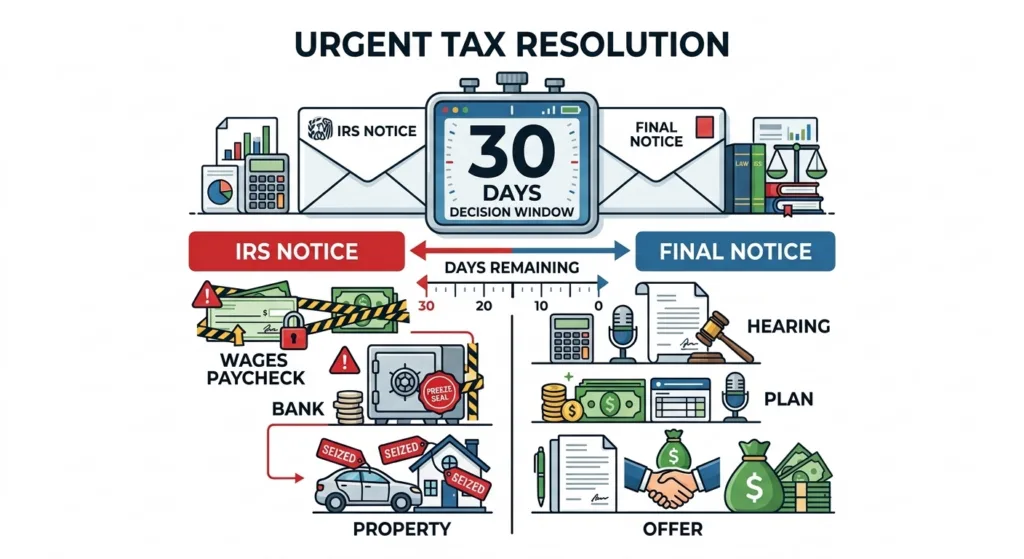
- A final notice of intent to levy. LT11 or Letter 1058 gives you 30 days to request a hearing before the IRS can levy wages or bank accounts. See our guide to Letter 1058 and LT11.
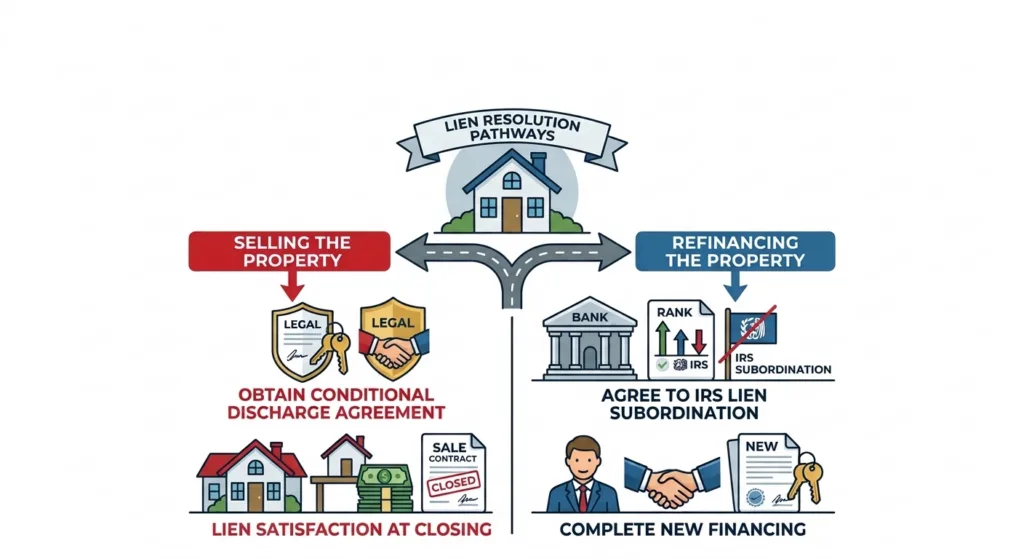
- A federal tax lien. A public claim against your property that can stall a sale or refinance. See selling or refinancing with an IRS lien.
- A private collection agency. Older balances that go quiet can be assigned to one of the IRS’s three private collectors.
A collection hearing at the LT11 stage will not reopen the audit. You can challenge the amount there only if you never received a notice of deficiency or never had another chance to dispute it.
Your State May Send a Bill Too
Federal audit changes rarely stay federal. Most states with an income tax require you to report a federal adjustment that raises your state tax, usually by filing an amended state return.
Deadlines vary by state. New York, for example, generally requires the report within 90 days of the final federal determination, and Georgia allows 180 days, according to accounting firm Aprio. Skipping the report can leave your state assessment window open for years.
Plan for both bills at once.
A payment plan built around the federal balance alone can fall apart when the state balance shows up months later.
Frequently Asked Questions
What happens if I owe money after an IRS audit?
The IRS assesses the added tax, penalties and interest, then mails a bill, usually Notice CP22E. If you do not pay or arrange a plan, the balance moves into regular IRS collection, which can lead to liens and levies.
What is a CP22E notice?
It is the IRS notice that says your return was changed because of an audit and that you owe money as a result. It asks for payment by the date on the notice’s payment coupon.
Can I dispute an IRS audit after I get the bill?
Often, yes. Audit reconsideration lets you ask the IRS to reopen the audit if you have new information, missed the audit or never got the report, as long as the tax is unpaid. It is not available after a closing agreement, a compromise or a final court decision.
What is audit reconsideration?
It is an IRS process that reopens a completed audit. You request it by letter or on Form 12661, with your audit report and copies of new supporting documents. IRS Publication 3598 explains the process.
How long do I have to pay after an IRS audit?
Pay by the date on your CP22E payment coupon to limit further penalties and interest. If you cannot, ask for a payment plan or another option before that date.
Can I get a payment plan for an IRS audit bill?
Yes. An audit balance can be paid through an IRS payment plan like any other tax debt. Interest and a reduced late-payment penalty continue while you pay.
Can I settle an IRS audit bill for less?
Possibly. An offer in compromise can settle a debt you cannot fully pay, and a separate offer based on doubt as to liability, Form 656-L, addresses tax you believe is wrong. The IRS decides whether to accept either.
Can the accuracy-related penalty be removed?
Yes, if you acted in good faith and had reasonable cause. First-time abatement does not cover the accuracy-related penalty.
Does interest on an audit bill start from the original due date?
Yes. Interest on the added tax runs from the original due date of the return, not from the date of the audit or the bill.
Will my state find out about my IRS audit?
Assume it will. Most states with an income tax require you to report federal changes that increase your state tax, and deadlines vary by state.
Before You Pay the Audit Bill
Read the letter, then answer the two questions in order. Is the amount right? If not, find which dispute route is still open for the letter you hold. If it is right, or close enough, choose a way to pay that you can actually keep up with, and plan for the state bill that may follow.
If an audit has left you with a balance due, Amro Badran, EA, Managing Partner of Badran Tax, and the firm’s licensed tax professionals can help.
With over 40 years of experience with IRS and state tax problems, and a team of Enrolled Agents, CPAs and tax attorneys joined by a former IRS agent, Badran Tax works with taxpayers in all 50 states to identify options and pursue resolution.
40+ Years of IRS & State Tax Resolution
Ready to Resolve Your Tax Problem?
Schedule a free, no-obligation consultation with our licensed tax professionals. We’ll review your situation, explain your options and map a path forward, however complex the issue.
Schedule Your Free Tax Consultation
or call toll-free: (855) 223-7268 | Monday–Friday, 9AM–5PM ET
Sources & Helpful Resources
- IRS: Understanding your CP22E notice
- IRS Publication 3598: The audit reconsideration process
- IRS: IRS audits
- IRS: Accuracy-related penalty
- IRS: Interest
- IRS: First-time abate and administrative waiver
- Taxpayer Advocate Service: Letter 525
- Taxpayer Advocate Service: Disagreeing with an assessment
- Aprio: Reporting federal adjustments to your state

Amro Badran, EA, is the Managing Partner of Badran Tax,
With over 40 years of experience and accreditation as a Federal Enrolled Agent,
Amro Badran and his team of tax professionals specialize in helping individuals and businesses resolve complex IRS & state tax issues and controversies.
Experienced and Trusted Tax Resolution Firm based in New Brunswick, NJ.
Disclaimer
This blog post is provided for educational and informational purposes only.
It does not constitute tax, legal, accounting, or financial advice and should not be relied upon as a substitute for professional counseling tailored to your specific situation.
Always consult a qualified tax advisor or legal professional before making decisions based on this content.
Use of this site or information herein does not create a professional relationship between you and BadranTax LLC or its principals. Any reliance on the material is solely at your own risk.
While we strive to provide accurate, up-to-date information, BadranTax makes no warranties, express or implied, regarding accuracy, completeness, or suitability of the content.
Links to external websites are provided for convenience only. BadranTax does not endorse and is not responsible for the content or practices of third-party sites.
BadranTax and its affiliates expressly disclaim all liability for any actions taken or not taken based on this information.